You may have seen scores listed as even par, two under, or three over on a golf scorecard or in a tournament broadcast. What is par in golf, and why is it so important to every leaderboard?
Par is the standard that determines how golf is played and scored. It sets the bar for birdies, bogeys, and tournament results, and it tells you what to expect on every hole.
Knowing par does more than just explain how to score. It makes you think differently about strategy, managing a course, and judging performance.
What does par mean in golf?
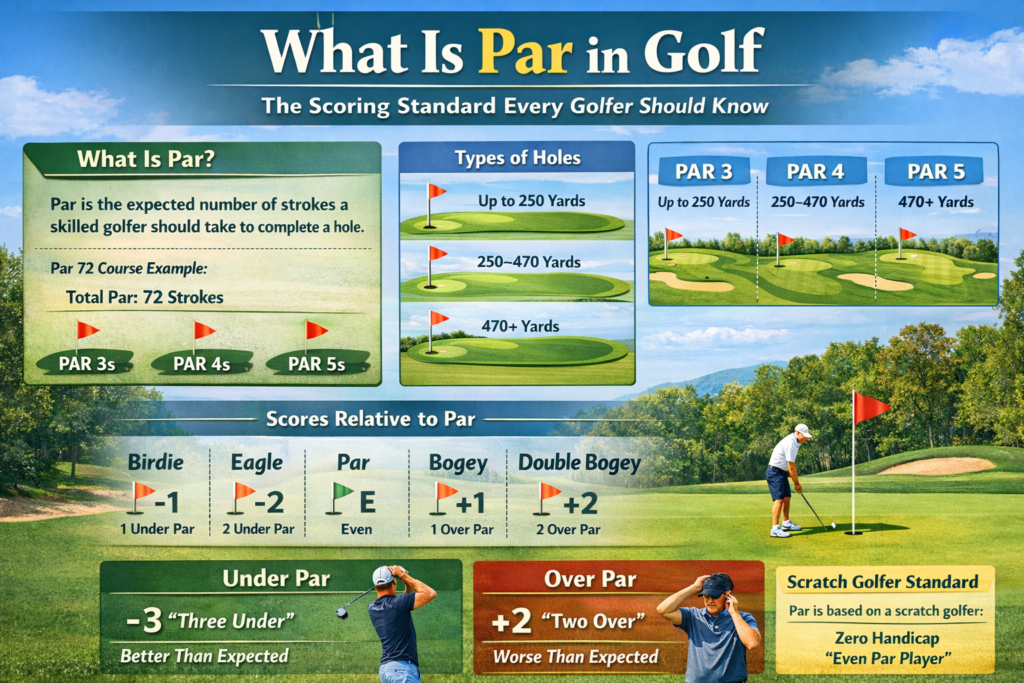
Par is the number of strokes that a skilled golfer, also known as a scratch golfer, is expected to take to finish a hole or an entire course in normal playing conditions.
Every hole on a course has a different par value. The course par is the number of strokes it takes to play all 18 holes. On a standard 18-hole course, this is usually between 70 and 72 strokes.
To put it simply:
- You met expectations if your score was equal to par.
- If you score lower than par, you did better than expected.
- You did worse than expected if you scored higher than par.
The most important thing about par is that it is the standard by which all golf scores are measured. Par is the reason we have words like birdie, bogey, eagle, and double bogey.
There would be no good way to compare how well players or tournaments did without par.
How Is Par Determined?
The distance from the tee to the green is the main factor that determines par. Also, it is generally believed that a good golfer should need two putts once the ball reaches the green.
This is a general formula for figuring out par:
- Strokes to get to the green
- Plus two putts
That number is equal to par.
A hole that takes two full shots to reach the green, for example, is usually called a par 4 (two approach strokes and two putts).
Distance is the most important factor, but it’s not the only one. Course architects and governing bodies like the USGA also look at other things when deciding on par values, such as:
- Changes in elevation (holes that go up or down)
- Forced layups and doglegs
- Bunkers and water hazards
- The weather
- Size and level of difficulty of the green
- Overall level of difficulty when playing in normal conditions
Yardage is still the most important factor in determining par classification, which is why hole length is the first thing we look at when deciding if a hole is a par 3, par 4, or par 5.
Who Is Par Based On?
Par is based on how well a scratch golfer, or someone with a zero handicap, plays.
A scratch golfer should be able to:
- Get to most greens in regulation
- Two putt every time
- Stay away from penalty strokes
Par might seem hard for people who play golf for fun, and that’s fine. Par is not the same as average play. It means a high level of play.
Types of Par: Par 3, Par 4, and Par 5 Holes
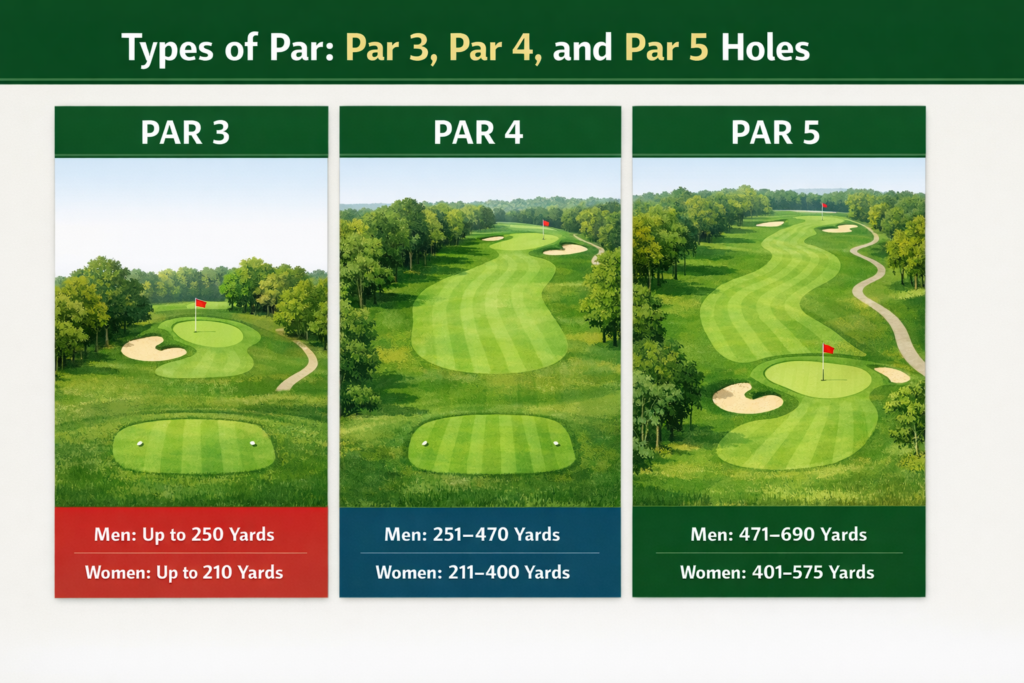
Most golf courses have holes that are par 3, par 4, or par 5. Each type is made to test a different mix of distance, accuracy, and strategy.
Par 3
The shortest holes on a course are the par 3 holes. A good golfer should be able to:
- Hit the green with the tee shot.
- Take two putts to finish the hole
Par 3s are all about accuracy and distance control because you only get one full swing before you reach the green. When you miss the green, you often have to try to get back up and down, which can lead to bogeys.
Typical yardage:
up to about 250 yards, but many par 3s are between 120 and 220 yards long, depending on the tees.
Par 4
On most golf courses, par 4 holes are the most common.
A good golfer should be able to do the following on a par 4:
- Get to the green in two strokes.
- Make two putts
These holes need a mix of distance and accuracy. A good tee shot makes it easier to get to the green, but a bad tee shot can make it hard to get there in regulation time.
typical yardage:
between 240 and 490 yards, depending on how the course is set up and which tee you choose.
Par 5
Par 5 holes are longer and usually give you a chance to score.
On a par 5, you should expect:
- Get to the green in three strokes
- Hit two putts
Long hitters might try to reach the green in two, which gives them a chance to make a birdie or eagle, but it also comes with risk.
Typical yardage:
The average distance is between 470 and 600 yards, but it can be more or less depending on the course design.
Rare Par Values
Sometimes, you might come across:
- Par 6 holes
- Very rarely, Par 7 holes
These are rare and usually only found on special, resort style, or very long courses. They aren’t part of standard championship layouts, but they are made to be different or to fit very long distances.
What does course par mean?
Course par is the number of strokes that a good golfer should be able to take to finish all 18 holes on a course. To find it, add up the par value of each hole on the layout.
This is what the hole distribution usually looks like on a standard par 72 course:
4 par-3 holes
10 par-4 holes
4 par-5 holes
Total: 72 strokes
Not all golf courses, though, are par 72. Depending on how long, how well designed, and how hard they are, some layouts are called par 70 or par 71.
When a player says they shot even par, it means that their score is the same as the course par.
For example:
The course par is 72
Score: 72
Result: Even par
If the same player scored 70 on a course with a par of 72, they would be two strokes under par. If they got 75, they would be three strokes over par.
What Do Under Par and Over Par Mean?
Under Par
Getting fewer strokes than the par that was set.
For example:
Par-5 hole
You score 4
Result: You are 1 under par (birdie)
In competitive golf, the goal is to score below par, which is how players move up the leaderboard.
Over Par
Scoring more strokes than the par set for the hole.
For example:
Par-4 hole
You score 6
Result: 2 over par (double bogey)
It’s normal for beginners to finish just over par as part of getting better.
How Par Relates to Handicaps
Par is the most important part of the golf handicap system.
A handicap tells you how many strokes over par a golfer usually hits.
For example:
Course par: 72
Player handicap: 15
Expected score: 72 + 15 = 87
This system lets golfers of all skill levels compete on an even playing field.
FAQS
Q: What does it mean to be even par?
A: If you have an even par, it means that your total strokes are equal to the course par.
Q: Why is par important in tournaments?
A: It makes scoring the same for all courses, so fans and players can compare their scores.
Q: Is par the same for both men and women?
A: Not all the time. Depending on the yardage, different tee boxes may have different assigned pars.
Q: What does par 72 mean?
A: For a scratch golfer, par 72 means that the total number of strokes expected for all 18 holes is 72.
Q: Why are there so many par 72 golf courses?
A: Many courses are par 70 or 71, but par 72 gives a good mix of hole types and strategic options.