Golf has its own unique scoring language. Terms like par, bogey, eagle, and albatross tell you how well a player did compared to what they were supposed to do on a hole. In these scoring terms, the birdie is one of the most common and well-known achievements in golf.
Birdies are very important for professional golfers who want to move up the leaderboard during tournaments.
Getting a birdie is often a memorable milestone for amateurs that shows they are getting better at their skills and managing the course.
Knowing what a birdie is and how it happens helps you understand golf scoring better.
This guide will teach you what a birdie is, how golfers score one, where the term came from, how common birdies are, and why they are important in both amateur and professional golf.
What Is a Birdie in Golf?
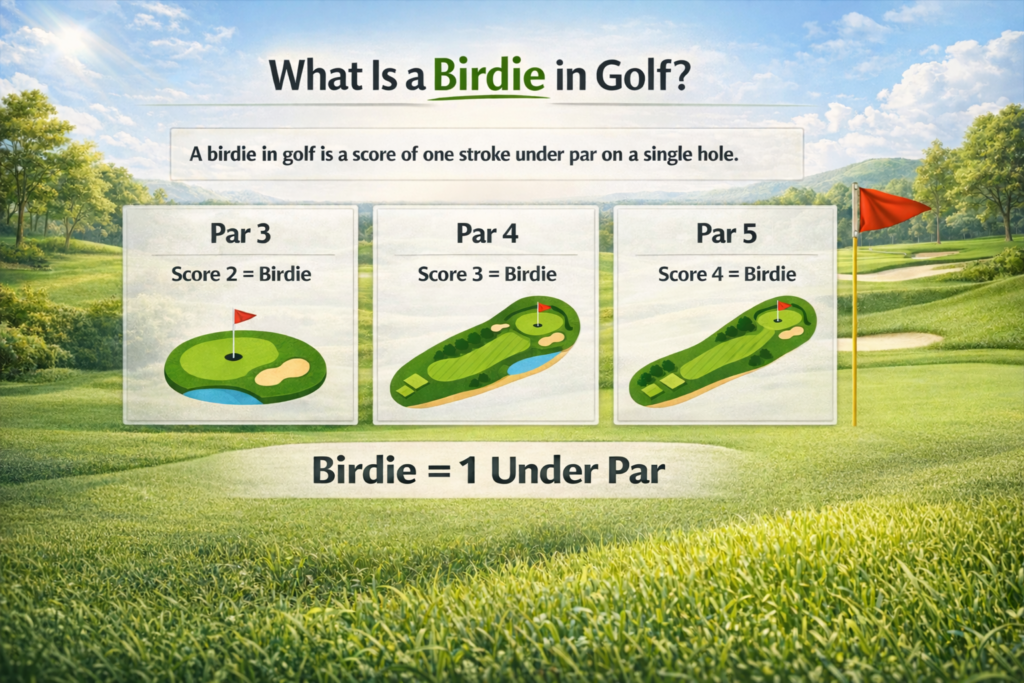
A birdie in golf means you hit the ball stroke under par on a single hole. It means that a golfer finishes the hole with one fewer shot than the expected number of strokes (par).
For example:
- Par-3 hole: score of 2 = birdie
- Par-4 hole: score of 3 = birdie
- Par-5 hole: score of 4 = birdie
Amateur golfers see birdies as a big achievement, and professional golfers often celebrate them because they help lower a player’s overall score during a round.
How to Score a Birdie
A golfer gets a birdie when they reach the hole efficiently and finish with one fewer stroke than par.
Here are some common situations where you can score a birdie:
Birdie on a Par-3
A golfer scores a birdie on a par-3 hole when they finish the hole in two strokes.
Example sequence:
- Tee shot lands on the green
- One putt into the hole
Total strokes: 2
This makes a birdie because the hole’s expected score was three.
Birdie on a Par-4
The most common holes on golf courses are par-4 holes.
Example sequence:
- Drive from the tee
- Approach shot onto the green
- One putt
Total strokes: 3
This means that the golfer finished the hole in one stroke under the expected four.
Birdie on a Par-5
Par-5 holes are often the best for getting a birdie.
Example sequence:
- Drive from the tee
- Second shot toward the green
- Third shot near the hole
- One putt
Total strokes: 4
This score is a birdie because the expected score is five.
Birdie vs Other Golf Scores
Golf scores are always measured relative to par. Knowing how birdies compare to other scores makes the scoring system clearer.
| Score | Meaning |
|---|---|
| Albatross | 3 under par |
| Eagle | 2 under par |
| Birdie | 1 under par |
| Par | Even |
| Bogey | 1 over par |
| Double Bogey | 2 over par |
Birdie is the most common under-par score for golfers to achieve during a round.
How often do birdies happen?
Birdies are common in professional golf, but they are far rarer in recreational golf.
Depending on course difficulty and weather conditions, professional golfers often make several birdies in a round.
For amateur golfers:
- Beginners: few or no birdies
- Intermediate players: occasionally birdies
- Low-handicap golfers: get 1 or 2 birdies each round.
This difference shows that birdies reflect improved putting, accuracy, and consistency.
Why Birdies Are Important in Golf
Lowering Total Score
Birdies lower a golfer’s total score because they are under par. Scoring multiple birdies over a full round can significantly improve your overall performance.
Tournament Momentum
Birdies help golfers move up the leaderboard in competitive golf. A string of birdies can change the outcome of a tournament very quickly.
Boost of Confidence
Making a birdie usually means hitting quality shots. This success gives you confidence and pushes you forward for the rest of the round.
How to Get More Birdies
Hit More Greens in Regulation
Getting to the green in regulation gives you more chances to make a birdie.
Get Better at Approach Shots
Accurate approach shots that land close to the hole make it more likely that you will make birdie putts.
Get Better at Putting
Good putting is very important. Most birdies come from making short to mid-range putts that go in.
Where the Word Birdie Came From
In early American slang, the word bird meant something great or impressive. That’s where the word birdie comes from.
In the early 1900s, golfers at Atlantic City Country Club in New Jersey started using the term “bird of a shot” to describe a great shot. Over time, this became the word “birdie” for scoring.
Later, golf scores were based on a bird theme:
- Birdie: 1 under par
- Eagle: 2 under par
- Albatross: 3 under par
FAQ
Q: Is a birdie a good score in golf?
A: Yes. A birdie is a good score because it means the golfer did better than the expected par.
Q: Is a birdie better than an eagle?
A: No. An eagle is better than a birdie because it is two strokes under par.
Q: How many birdies do pros get in a round?
A: Depending on the conditions, professional golfers usually make three to five birdies per round.
Q: How often do amateur golfers get a birdie?
A: Beginners don’t get birdies very often, but as they get better at putting and hitting the ball, they become more common.
Q: How many birdies should you get in one round?
A: Even one birdie in a round is a good result for recreational golfers. More experienced players may try to get two or more, while professional golfers often make several birdies per round, depending on course difficulty.