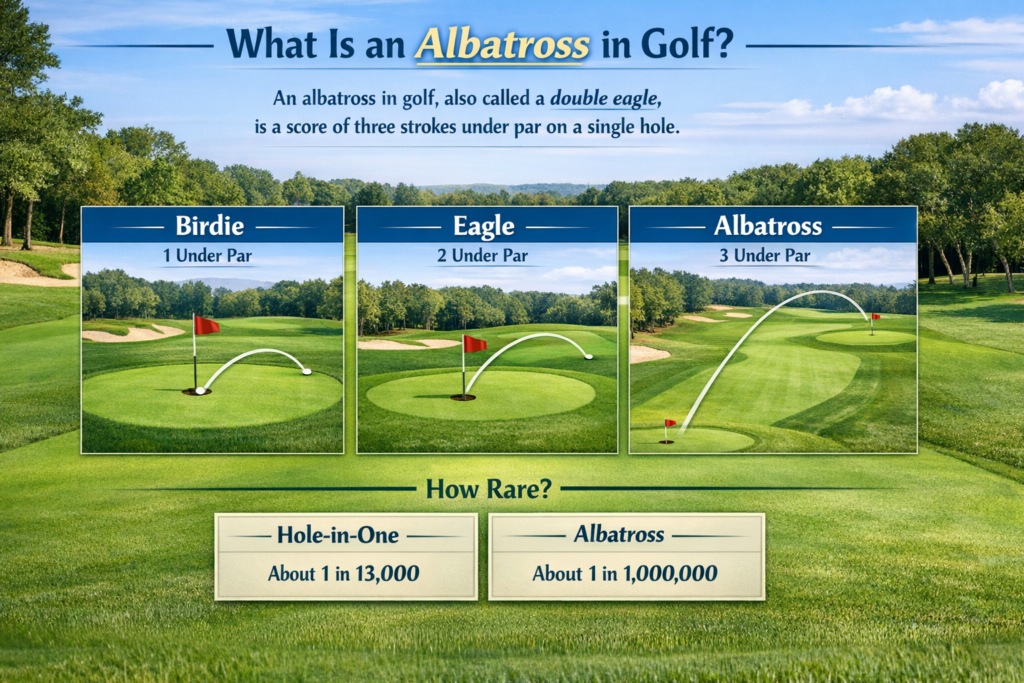
There are unique words in golf that describe how a player performs compared to par, like birdie, eagle, and bogey.
The albatross is one of the rarest and most exciting things you can achieve in the game.
A lot of golfers never see one in their whole lives. Even professional players don’t often experience it. So what is an albatross in golf, and why is it so special?
We will talk about what an albatross is, how it happens, why it is so rare, and how it is different from other golf scoring terms in this guide.
What Does Albatross Mean in Golf?
An albatross in golf is a score of three strokes under par on a single hole. In the US, it is sometimes called a double eagle.
For example:
Par-5 hole
Score: 2
Result: Albatross
Par-4 hole
Score: Hole in one
Result: Albatross
In both cases, the player finished the hole three shots better than par, the expected score for that hole.
An albatross is widely considered to be one of the hardest things to do in golf because it requires extremely accurate and powerful shots.
How an Albatross Happens
There are usually two ways that an albatross happens.
1. Scoring an Albatross on a Par-5
This is what commonly happens.
For example:
- Drive from the tee box
- Long second shot, usually with a fairway wood or long iron
- The ball goes straight into the hole.
This means a score of 2 on a par-5, which is three strokes under par.
2. Hole in One on a Par-4
This happens when a player hits the ball directly into the hole on a par-4.
If you finish in one shot, that means three under par, which is an albatross because the expected score is 4 strokes.
This situation is even rarer because most par-4 holes are too long to reach in one shot.
How Rare Is an Albatross in Golf?
It’s even rarer to get an albatross than a hole-in-one.
Estimated chances:
- Hole in one: about 1 in 13,000
- Albatross: roughly 1 in 1,000,000 or more
Only a small number of albatrosses are seen around the world each year, but there are many more hole-in-ones.
Because of this rarity, many golfers consider an albatross even more impressive than a hole-in-one.
Albatross vs Other Golf Scoring Terms
This is how an albatross compares to other golf scores relative to par.
| Score | Strokes Relative to Par |
|---|---|
| Birdie | 1 under par |
| Eagle | 2 under par |
| Albatross | 3 under par |
| Condor | 4 under par (extremely rare) |
Why the Term Albatross?
A lot of golf scoring terms are based on birds:
- Birdie: 1 under par
- Eagle: 2 under par
- Albatross: 3 under par
The name means something significant and rare. The albatross bird has one of the biggest wingspans in the world, which represents something remarkable, just like the golf achievement.
Famous Albatross Shots
There have been a few famous albatrosses in professional golf, but they are very rare.
Louis Oosthuizen: 2012 Masters
One of the most well known examples took place at Augusta National.
On the par-5 second hole, Louis Oosthuizen hit a 4-iron from more than 250 yards away, and the ball rolled into the cup for an albatross.
It is still one of the most famous shots in Masters history.
Patrick Reed: U.S. Open
Patrick Reed recorded an albatross on a par-5 during the U.S. Open, becoming one of only a few players in tournament history to achieve the feat.
Why It’s So Hard to Score an Albatross
This achievement is very hard for a number of reasons.
Distance Requirements
A golfer must hit the green from long range in two shots to get an albatross on a par-5. A lot of amateur golfers just can’t hit the ball far enough.
Must Have Accuracy
The ball must go straight into the hole from far away, even if a player gets to the green in two shots. That requires a perfect mix of:
- Strength
- Accuracy
- A little bit of luck
Limited Chances
During a round, players may only come across a few reachable par-5 holes. This means that the chance to even try for an albatross is limited.
Tips That Can Increase Your Chances
An albatross is very rare, but there are some things you can do to slightly increase your chances.
Improve Driving Distance
If you drive longer, you have a better chance of hitting par-5 greens in two shots.
Improve Your Long Iron Accuracy
A lot of albatross shots come from far away, so it’s important to be accurate with long clubs.
Be Smart on Par-5 Holes
Sometimes, playing aggressively but with a plan can open up a chance.
FAQ
Q: Are double eagles and albatrosses the same thing?
A: Yes. A double eagle is a term that golfers in the United States often use, but both terms mean scoring three strokes under par on a single hole.
Q: Can you get an albatross on a par-3?
A: No. A hole-in-one is the lowest score you can get on a par-3, which is two under par, called an eagle.
Q: Is an albatross more rare than a hole-in-one?
A: Yes. An albatross is much rarer than a hole-in-one, according to statistics.
Q: What is the rarest score in golf?
A: A condor is technically rarer than an albatross, but it has only been seen a few times in golf history.
Q: On What Holes Can You Score an Albatross?
A: You can only get an albatross on par-4 or par-5 holes. A golfer usually scores a 2 on a par-5 when they hole their second shot from the fairway.
On a par-4, a player gets an albatross with a hole-in-one from the tee. It can’t happen on a par-3 because the lowest score there is an eagle.